
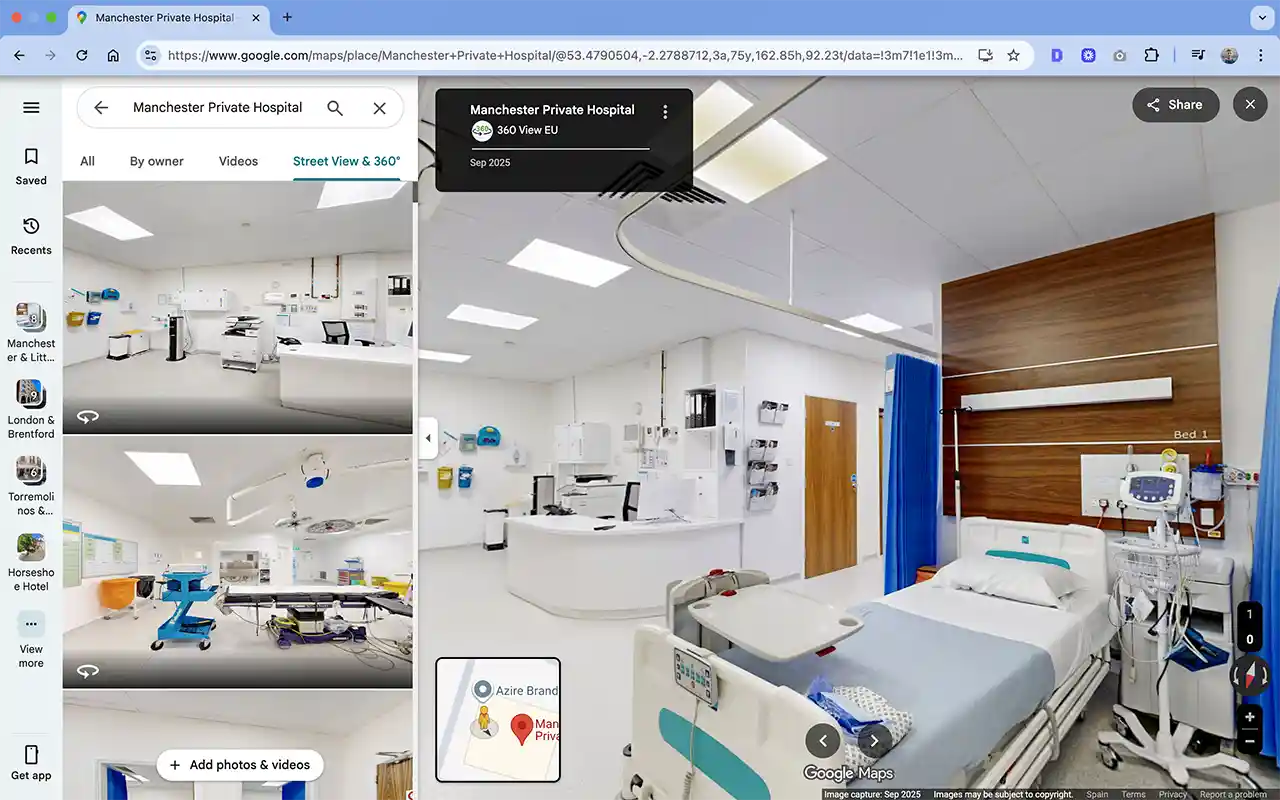
AI Browsing and the Rise of the Metaverse: Why Instant 360 Views Are Changing How We Explore Businesses Online
Discover how AI browsing and immersive virtual tours are redefining how customers explore real spaces online.
The New Era of Exploration: “Show Me Inside”
A few years ago, people searched online using words and pictures.
Today, they step inside.
Thanks to platforms such as Google Maps, Google Street View, Apple Maps, YouTube, Meta (Facebook), Matterport, Zillow 3D Home, Kuula, CloudPano, Concept3D, and EyeSpy360, anyone can now explore real-world spaces virtually. From hospitals and hotels to schools and shopping centres, every type of space can now be experienced in seconds.
AI-powered browsing allows anyone to say, “Show me inside Manchester Private Hospital,” or “Take me on a 360 tour of a London hotel,” and instantly walk through the space. This shift from reading about places to experiencing them is transforming how people search, trust, and choose where to go.
What AI Browsing and the Metaverse Really Mean
AI browsing uses artificial intelligence to explore the web visually and interactively instead of relying on text or photos.
It connects map data, imagery, and digital twins so that users can see and move through real environments directly in search results.
The metaverse is not a fantasy world or virtual game. It is the internet becoming spatial, where websites are replaced by real locations you can explore. Each time you view a Street View tour or a Matterport model, you are already inside it.
Tech giants have invested billions to make this happen.
Google has spent years mapping every street and building 360 coverage for the world.
Apple has built its 3D Look Around experience city by city.
Meta is developing immersive video and virtual environments for global use.
Matterport has digitised more than 40 billion square feet of real space.
Now AI is connecting all these systems, allowing instant visual exploration from any device.
These are not future ideas. The transformation started years ago, and AI is simply speeding it up.
Why This Shift Matters for Businesses
For customers, exploration is instant.
For businesses, visibility now depends on being part of that visual layer of the web.
AI assistants such as Google Gemini, Bing Copilot, and Siri can already respond to natural questions like, “Show me a café near me I can explore inside.” They display immersive tours, not just links.
That means only businesses with 360 content are shown.
The world has moved from static discovery to experience-based discovery.
Being found is no longer enough.
You must be experienced.
The Platforms Powering the Immersive Internet
Google Maps and Street View
The foundation of instant exploration. Millions of businesses allow customers to walk inside.
Apple Maps and Look Around
Apple’s high-resolution 3D experience that blends navigation with realistic exploration.
Matterport
A global leader in 3D scanning and digital twins, transforming buildings into explorable virtual spaces.
YouTube and Meta
Hosts of interactive 360 videos used for marketing, storytelling, and education.
Zillow 3D Home, Kuula, CloudPano, EyeSpy360, Concept3D
Accessible tools that help small businesses and schools create affordable virtual tours.
Together, these systems form the next generation of the internet, a connected, visual, and explorable version of the real world.
How User Behaviour Has Changed
People no longer browse lists of links. They explore places.
Voice and visual search are now the fastest-growing search methods worldwide.
When someone says, “Show me inside,” AI tools prioritise content that offers a real view.
Businesses without immersive content simply disappear from results.
This shift is permanent. Customers expect to experience a place before visiting.
Those that adapt early will gain visibility, trust, and bookings.
Those that do not may lose them overnight.
The Industries Being Transformed
Real Estate
Buyers walk through homes remotely before booking viewings. Agents using Matterport or Zillow 3D Home sell faster and reach global audiences.
Healthcare
Hospitals and clinics, such as Manchester Private Hospital, use virtual tours to reduce patient anxiety and build trust before appointments.
Retail and Hospitality
From cafés and boutiques to hotels and resorts, people now explore interiors on Google Street View or Apple Maps before they visit.
Events and Venues
Organisers evaluate size and layout using 360 tours from Kuula or EyeSpy360, saving time and travel.
Education and Tourism
Universities, museums, and tourist destinations use Concept3D and Matterport to create virtual experiences.
Across every sector, immersive exploration turns curiosity into confidence and confidence into sales.
The Risk of Being Left Behind
This change is happening fast and globally.
Businesses that rely only on websites, photos, or social posts are already invisible to AI-driven search.
When someone asks their phone to “show me inside,” only immersive listings appear.
The cost of not adapting is real: fewer clicks, less foot traffic, and shrinking relevance in search results.
Revenue can fall without warning, not because of poor service but because people can no longer find or experience your space.
How to Stay Visible in the AI Era
To stay competitive and relevant, every business should:
- Make their location explorable through a 360 virtual tour.
- Optimise their Google and Apple Maps profiles with immersive content.
- Integrate Street View, Matterport, or 360 embeds directly on their website and social channels.
- Keep content up to date so AI tools always display an accurate environment.
The classic model of marketing, SEO, and basic optimisation is no longer enough.
AI has changed the discovery journey. Businesses must now show real environments, not just describe them.
Watch how AI browsing works in real time
This 20-second demo shows how Perplexity instantly opens a 360° virtual tour inside Manchester Private Hospital.
AI Browsing Demo: Perplexity instantly opens a 360° virtual tour inside Manchester Private Hospital.
The Internet Metaverse Is Already Here
The metaverse is not coming. It is already here.
Every Street View image and Matterport scan adds to a shared 3D layer of the world, connected by AI.
Soon, customers will not read about businesses; they will walk through them in real time, guided by personalised AI recommendations.
Those who invest now in virtual transparency will lead tomorrow’s market.
Those who wait may disappear from it.
Step Into the Future
Businesses that integrate 360 virtual tours, Google Street View, and Matterport digital twins are shaping the next version of the internet.
If you manage a clinic, venue, office, or retail space, now is the time to prepare for AI browsing and immersive search.
Show people what words cannot describe.
Let them walk through your world before they visit.
Explore how 360 View can help your business be seen, understood, and trusted online.
Visit our Google Virtual Tour service page or discover our latest immersive projects.
FAQ
What does AI browsing mean in simple terms?
AI browsing is when smart browsers like ChatGPT Atlas or Perplexity Comet search, read, and act for you. You simply ask a command, and the AI finds what you need, opens pages, and completes tasks such as showing a virtual tour on Google Maps or making a booking automatically.
What is the metaverse and how does it relate to virtual tours?
The metaverse is the evolution of the internet into a 3D, interactive space where people can explore real or digital environments. Every Google Street View or Matterport tour contributes to this connected “spatial web,” allowing users to experience real places virtually through AI-powered platforms.
How do 360 virtual tours help businesses rank higher online?
360 virtual tours increase engagement, time on profile, and trust—three key factors that improve visibility on Google and AI search tools. Businesses with immersive content are more likely to appear in Google Maps, local search, and voice assistant recommendations.
Do Google Street View and Matterport tours affect SEO results?
Yes. Both Google Street View and Matterport improve local SEO by making listings more interactive and complete. Google’s ranking systems favour verified imagery and 360 content that helps users explore before visiting.
What is a digital twin in simple words?
A digital twin is a precise 3D copy of a real space, created using laser scanning or photogrammetry. It allows anyone to walk through the location virtually, measure areas, or plan changes—just like being there in person.
Which platforms support 360 virtual tours and digital twins?
Popular platforms include Google Maps, Apple Maps Look Around, Matterport, Kuula, CloudPano, EyeSpy360, Concept3D, and Zillow 3D Home. Each serves different needs, from small business showcases to large-scale architectural twins.
How is AI changing how people discover businesses online?
AI tools such as Google Gemini, Bing Copilot, and ChatGPT now understand real-world spaces. They can show users immersive results like 3D tours instead of simple links, making visual content a key factor in online discovery.
What happens if my business does not have a 360 virtual tour?
Without a tour, your business may not appear when AI tools or voice assistants are asked to “show inside.” Competitors with immersive content will dominate local search, attract more clicks, and convert more customers.
Which industries benefit most from Google Street View and Matterport tours?
Industries that benefit most include healthcare, real estate, retail, hospitality, education, tourism, and events. Any space people want to understand or trust before visiting—like a clinic, hotel, or campus—gains from immersive visuals.
How do virtual tours help patients and visitors in healthcare?
Virtual tours help patients see entrances, waiting areas, and treatment rooms before arriving, reducing anxiety and improving wayfinding. Hospitals and clinics use them to increase transparency and patient confidence.
How much does it cost to create a 360 virtual tour?
Costs vary by space size, location, and platform. In the UK, small shops or clinics typically start around £300–£600, while large venues or campuses using Matterport Pro3 or LiDAR scanning may range from £1,000 to £3,000 including hosting and setup.
Is Matterport the best option for creating a virtual tour?
Matterport is the industry leader for 3D scanning and digital twins. It offers high accuracy, depth data, and AI floor plan generation. However, Google Street View, Kuula, or CloudPano may be more affordable for smaller businesses focused on map visibility.
How should a business prepare its space before a virtual tour shoot?
Tidy, declutter, and ensure good lighting. Open doors, turn on lights, and check signage or branding. The goal is to show your space at its best—clean, bright, and welcoming.
How long does it take to capture a 360 or Matterport tour?
Small spaces can be scanned in one to two hours. Larger properties like hotels or schools may take several hours or a full day. Processing and upload usually take an additional 24–48 hours before the tour is ready to publish.
Who owns the virtual tour once it is created?
You usually own the imagery rights, while the hosting provider (such as Google or Matterport) manages where it’s displayed. Always confirm in your agreement that you can download or reuse your tour across websites and social media.
How can I add my virtual tour to my website or social media?
Your provider will give you an embed code or direct link. You can insert it into your website or share it on social media platforms. On Google Business Profiles, it appears directly under “See Inside.”
How often should a business update its virtual tour?
Update your tour whenever your layout, branding, or interiors change significantly. Most businesses refresh their imagery every one to two years to keep listings accurate and aligned with AI and Google Map updates.
How do privacy and data protection work with 360 tours?
Faces, car plates, and sensitive details can be blurred during editing. Businesses decide which areas to include or exclude. Matterport and Google both comply with GDPR and privacy regulations when publishing imagery.
How can a business measure the success of a 360 virtual tour?
Track engagement through Google Business Insights, Matterport analytics, and website data. Look at views, click-throughs, direction requests, and booking conversions to measure impact and return on investment.
What are the first steps to create a virtual tour for my business?
Start by choosing your preferred platform (Google, Matterport, or others). Get a quote from a certified provider, prepare your space, and schedule the scan. Once published, promote your tour on Google Maps, your website, and social media to maximise exposure.
Explore more from 360 View: Indoor Google Street View services, Matterport Digital Twins, boosting your 3D tour online visibility, business 360 virtual tours, get in touch with our team.
Frequently Asked Questions
What’s the data size of a virtual tour?
Depending on scope, tours range from 50MB to 500MB+. Most load quickly on standard connections. 360 View optimises file sizes to balance quality with fast loading.
How do virtual tours reduce customer hesitation?
Customers see exactly what to expect before arriving, reducing uncertainty. This builds confidence in booking decisions, whether choosing a restaurant, hotel, clinic, or service provider.
Can I embed a virtual tour on my website?
Yes. 360 View provides embed code that works on any website builder—WordPress, Wix, Shopify, or custom-built. Simply paste the code and your tour displays directly on your page.
What factors affect the price of a virtual tour?
Pricing depends on property size, number of rooms, complexity, location, and package type. Matterport tours cost more than Google Street View. Contact 360 View for a tailored quote.
How should I prepare my space for virtual tour capture?
Clean and tidy thoroughly. Remove clutter, personal items, and temporary objects. Good lighting helps—open curtains and turn on lights. 360 View provides a preparation checklist before your booking.


